Wednesday, April 23, 2014

Opponent Process Theory Diagram


Opponent Process Theory

Sensation and Perception Notes

Sensation and Perception

  • Sensation: Your window to the world
  • The process by which our sensory receptors and nervous system receive stimulus from the environment
  • Perception: Interpreting what comes in your window
  • Bottom-Up v. Top-Down Processing
  • Bottom-Up- Begins within the sense receptors and works up to the brain's integration of sensory information (Thalamus)
  • Top-Down Processing- Information processing guided by higher level mental processes
  • Absolute Threshold
  • The minimum stimulation needed to detect a stimulus 50% of the time
  • Difference Threshold
  • The minimum difference that a person can detect between two stimuli
  • Also known as Just Notable Difference
  • Weber’s Law
  • The idea that, to perceive a difference between two stimuli, they must differ by a constant percentage; not a constant amount
  • Signal Detection Theory
  • Predicts how we detect a stimulus amid other stimuli
  • Assumes that we do not have an absolute threshold
  • Sensory Adaptation
  • Decreased responsiveness to stimuli due to constant stimulation
  • Selective Attention
  • The focusing of conscious awareness on a particular stimulus
  • Cocktail-Party Phenomenon
  • Ability to focus one’s listening attention on a single talker among a mixture of conversations and background noises, ignoring other conversations
  • Form of selective attention

Language/Thought Notes

Language
  • Spoken/Written/Gestured words we use to communicate
  • Phonemes
  • Smallest distinctive sound unit in a spoken language
  • Morphemes
  • Smallest unit with meaning (prefix/suffix)
  • Grammar
  • Rules in language
  • Semantics
  • Set of rules by which we derive meaning
  • Adding “ed” makes word past tense
  • Syntax
  • Rules for making words into correct sentences
  • Stages of language development:
  • Babbling Stage- 3-4 mos.; infant makes spontaneous sounds
  • One-word stage- 1-2 yrs.; one word to communicate large messages
  • Two-word Stage- 2 yrs.; Two words to communicate meanings (telegraphic speech)
  • Skinner
  • Explain language through social learning theory (imitates then gets reward)
  • Chomsky- Inborn Universal Grammar
  • Acquire language too quickly
  • “Learning box”
  • Whorf’s Linguistic Relativity
  • Language determines way we think
  • No past tense = no thinking of past
  • Thinking Without Language
  • Think in words and mental pictures
  • Kohler
  • Chimps can problem solve
Thought

  • Cognition-Thinking, knowing, remembering
  • Concepts- similar to Schemas
  • Grouping of similar things
  • Prototype- Best example
  • Algorithm- Logical procedure to solving something
  • Heuristics- Strategy that allows us to make judgements and solve problems efficiently
  • Short cut that is prone to error
  • Insight- sudden solution
  • Confirmation Bias- wanting to search for evidence to confirm preconceptions
  • Fixation- Inability to see problem from different perspective
  • Mental Set- Approach something in particular way
  • Functional Fixedness- Think of things only in their useful function
  • Types of Heuristics:
  • Representativeness- Judging something by our prototype; may ignore something important
  • Availability- Estimating likelihood of events on availability in memory
    • It it comes to mind easily, it’s common
  • Overconfidence- Be more confident than correct
  • Overestimate personal accuracy
  • Framing- Way an issue is posed
  • Can drastically effect judgement
  • Belief Bias- One’s prior beliefs affect logical reasoning
  • Belief Perseverance- Sticking to thoughts even after source is proven wrong

Intelligence

  • The ability to learn from experience, solve problems, and use knowledge to adapt to new situations
  • Culturally specific
  • Factor Analysis- Statistical procedure, identifies clusters of related items on a test
  • General Intelligence- Charles Spearman
  • Multiple Intelligences- Howard Gardner: Studied savants (limited mental ability except in one area)
  • Types:
  • Visual/Spatial
  • Verbal/Linguistic
  • Logical/Mathematical
  • Bodily/Kinesthetic
  • Musical/Rhythmic
  • Interpersonal
  • Intrapersonal
  • Natural
Sternberg’s Aspects:
  • Analytical-problem solving
  • Creative-novel ideas
  • Practical-everyday tasks
  • Emotional Intelligence
  • Ability to perceive, express, understand, regulate emotion
  • Assessing Intelligence
  • Alfred Binet and Theodore Simon- Mental Age: what person of particular age should know
  • IQ= (Mental Age/Chronological Age)100
    • Doesn’t work with older people
  • Wechsler Adult Intelligence Scale (WAIS) Uses factor analysis
Aptitude
  • Test designed to predict person’s future performance
  • Learning ability
  • Achievement
    • Assess what person has learned
  • Tests must be:
    • Standardized: Pre-tested, form normal distribution/bell curve
      • Flynn Effect: Chart rises
    • Reliability: Consistent
    • Validity: How much a test measures what its supposed to
      • Predictive
      • Content
  • Changes over time depending on type of intelligence (crystallized or fluid)
  • Groups affect intelligent test scores
Tests discriminate but we must look deeper

Ear Diagram


Fully Labeled Ear Diagram

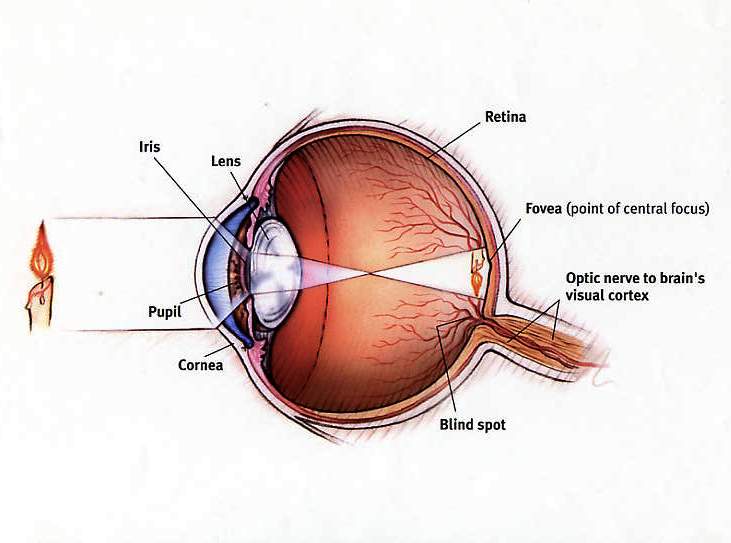
Eye Diagram

 Fully Labeled Eye Diagram

Tuesday, April 22, 2014

Moral Development


Moral Development
  • Lawrence Kohlberg

  • Pre-Conventional Morality
    • Morality based on rewards and punishments
    • If you are rewarded then it is okay
    • If you are punished, the act must be wrong
  • Conventional Morality
    • Look at morality based on how others see you
    • If your peers, or society, thinks it is wrong, then so do you
  • Post-Conventional Morality
    • Based on self-defined ethical principles
    • Your own personal set of ethics

Social Development

Social Development

  • Up until about a year, infants do not mind strange people (maybe because everyone is strange to them)
  • At about a year, infants develop stranger anxiety
  • Separation Anxiety- A child is separated from his/hers parents
  • Attachment:
    • The most important social construct an infant must develop is attachment (a bond with a caregiver)
    • Lorenz discovered that some animals form attachment through imprinting
    • Harry Harlow and his monkeys
    • Harry showed that monkeys needed touch to form attachment
    • Critical Periods: The optimal period shortly after birth when an organism’s exposure to certain stimuli or experiences produce proper development
    • Those who are deprived of touch have trouble forming attachment when they are older
    • Types of Attachment: (Mary Ainsworth’s Strange Situation)
      • Secure
      • Avoidant
      • Anxious/Ambivalent
  • Parenting Styles:
    • Authoritarian Parents
      • Parents are the bosses
      • You have no say so
      • Can not question them
    • Permissive Parents (Laissez Faire)
      • Children are bosses
    • Authoritative Parents
      • Democratic
      • Children participate in decisions that affect their life
      • Parents and children compromise
  • Erik Erikson
    • Neo-Freudian
    • Thought our personality was influenced by our experiences with others
    • Stages of Psychosocial Development
      • Trust v. Mistrust
        • Is my world predictable and supportive?
        • The trust or mistrust they develop can carry on with the child for the rest of their lives
      • Autonomy v. Shame and Doubt
        • Toddlers begin to control their bodies (toilet training)
        • Control temper tantrums
        • Big word is “NO”
        • Can they learn control or will they doubt themselves?
        • Around 2-3 years old
      • Initiative v. Guilt
        • Word turns from “No” to “Why?”
        • Want to understand the world and ask questions
        • Is their curiosity encouraged or scolded?
        • Around 5-6 years old
      • Industry v. Inferiority
        • Are they worthless or successful?
        • School begins
        • We are for the first time evaluated by a formal system and our peers
        • Do we feel good or bad about our accomplishments?
        • 6-12 Years Old
      • Identity v. Role Confusion
        • In our teenage years we try out different roles
        • Who am I?
        • What group do I fit in with?
        • If I do not find myself I may develop an identity crisis
        • Around Teenage Years
      • Intimacy v. Isolation
        • Have to balance work and relationships
        • WHat are my priorities?
        • Around 19-20 Years Old
      • Generativity v. Stagnation
        • Is everything going as planned?
        • Am I happy with what I created?
        • Mid-Life Crisis
        • Around 40-50 Years Old
      • Integrity v. Despair
        • Look back on life
        • Was my life meaningful or do I have regret?
        • Older People

Cognitive Development

Cognitive Development

    • It was thought that kids were just stupid versions of adults
    • Jean Piaget said kids learn differently than adults
  • Schemas
    • Children view the world through schemas (as do adults for the most part)
    • Schemas are ways we interpret the world around us
    • It is basically what you picture in your head when you think of anything
  • Assimilation
    • Incorporating new experiences into existing schemas
  • Accommodation
    • Changing an existing schema to adopt to new information
  • Stages of Cognitive Development (Jean Piaget)
    • Sensorimotor Stage
      • Experience the world through our senses
      • Do not have object permanence
      • Around 0-2 Years Old
    • Preoperational Stage
      • Have object permanence
      • Begin to use language to represent objects and ideas
      • Egocentric: Cannot look at the world through anyone’s eyes but their own
      • Around 2-7 Years Old
      • Cannot Grasp Conservation
        • Idea that a quantity remains the same despite changes in appearance and is part of logical thinking
    • Concrete Operational Stage
      • Can demonstrate concept of conservation
      • Learn to think logically
    • Formal Operational Stage
      • Abstract reasoning
      • Manipulate objects in our mind without seeing them
      • Hypothesis testing
      • Trial and Error
      • Metacognition
      • Not every adult gets to this stage
  • Types of Intelligence
    • Crystallized Intelligence
      • Accumulated knowledge
      • Increases with age
    • Fluid Intelligence
      • Ability to solve problems quickly and think abstractly
      • Peaks in the 20’s and then decreases over time

Wednesday, April 2, 2014

Lobes of the Cerebral Cortex


This is the Cerebral cortex, with its four lobes labeled.

Frontal Lobe:  Considered to be the emotional control center and home to the personality of a human being. It is involved in motor function, spontaneity, memory, language, initiation, problem solving, judgement, impulse control and social as well as sexual behavior.

Temporal Lobe: The right temporal lobe of the brain is used for purposes such as problem solving, decision making, motor behavior and also impulse control. It is also used for making judgements for memory, social behavior and sexual behavior.

Occipital Lobe: Control mostly vision, color recognition, and other vision related tasks within 
the brain.

Parietal Lobe: Receives sensory input for touch and body position.

.